For over twenty years Mrs Lillian Bunsen had lived comfortably in her white terraced stucco on a pleasant curved crescent in the heart of leafy Belgravia. For the last seven years the only occupants of the house were Mrs Bunsen, her cat, Duchess, and Dodds, the live-in girl.
After it became clear the war with Germany was not going to be over any time soon, that it was, in fact, getting worse, Mrs Bunsen had been amazed when Dodds had announced she was joining the Wrens.
At first Mrs Bunsen was sure she’d misheard Dodds. ‘You’re going to the fens?’ She’d asked, confused, (Dodds never went anywhere).
‘No, Mrs Bunsen.’ Dodds had cleared her throat. ‘I said, I’M JOINING THE WRENS. You know, the W.R.N.S.’
Mrs Bunsen had blinked. The world was going mad, of course. But she would never have dreamed of such nonsense from Dodds.
Dodds was one of those thin, faded creatures of indeterminable age. Most definitely the wrong side of thirty-five. Mrs Bunsen had always imagined Dodds would stay with her forever. She harboured a treasured secret image of Dodds weeping at her graveside, wondering what an earth she would do without her trusted employer, returning to sixty-four Chester Square and crying softly all over again at the sight of Mrs Bunsen’s empty armchair with its pink tasselled antimacassars. Mrs Bunsen pictured Dodds slinking dutifully upstairs, head bowed, perching on the end of Mrs Bunsen’s recently departed bed, bringing a corner of of the eiderdown to her nose and taking a hearty sniff.
Surely Dodds was perfectly comfortable at sixty-four Chester Square? She certainly couldn’t do any better. All that was required of Dodds was the preparation of their meals, a little light cleaning, the management of Mrs Bunsen’s social calendar and a few daily errands. Many of the rooms at number sixty-four were closed, covered in dust sheets and smelling of moth balls. And seeing as the two of them always took their main meal at noon, in the evenings, Dodds had only to prepare their simple scratch suppers – usually involving eggs (these days mostly Spam). After supper they would sit together listening to the wireless as Dodds hemmed Mrs Bunsen’s petticoats or knitted silly little hats for the nephews Dodds saw once a year during her annual January leave.
‘But surely you’re too old?’ Mrs Bunsen had said, after Dodds had made this ridiculous announcement about the Wrens.
Dodds had shaken her head. ‘They’ve changed the rules. ‘Besides,’ she said, shyly, ‘I served in the last war and that makes a difference.’
Mrs Bunsen often conveniently forgot about Dodds’ service record. It seemed so ridiculous. Dodds— at war! She would never have believed it if it wasn’t for the photograph Dodds kept on her nightstand. Dodds, a small scrap of a girl in 1918, only just sixteen, wearing her crisp uniform and smiling coyly at the camera.
‘I should have thought that experience would put you off,’ Mrs Bunsen said with a note of bitterness.
‘Oh, no,’ said Dodds mildly. ‘Of course it was awful. There are things I saw I’ll never forget. But there were hopeful times too. And to think you’re actually making a difference. . . ’
‘I should have thought you could make enough of a difference here,’ Mrs Bunsen said, waving a hand in the air to indicate she meant sixty-four Chester Square. ‘Houses don’t run themselves, you know.’
‘They don’t,’ said Dodds quietly. She straightened her shoulders. ‘All the same, I shall be off at the end of the week.’
Mrs Bunsen was flabbergasted. The end of the week? She turned to the sideboard so that Dodds should not witness her distress.
But what will I do? Mrs Bunsen thought. She had never lived alone before. There had always been servants. At one time there had even been a husband.
Mrs Bunsen had been widowed young and had come to think of those few years when she was married as a time of brief inconvenience. She remembered various snuffling and snoring noises coming from the other side of the bed at night, whisker hairs in the soap dish, the rustling of a newspaper at breakfast, and a black umbrella left next to the umbrella stand in the hallway that she was constantly tripping over.
Living without a man had never been a hardship but living without a single servant was something quite different. Especially with the war dragging on. Even Dodds had insisted on installing an Anderson shelter in the garden. Such an eyesore! Mrs Bunsen had thought as she’d watched Dodds heaving sheets of corrugated iron over her lawn. Each night when the siren went, Dodds would scuttle down to the shelter. Mrs Bunsen had tried the shelter once or twice but there was something terribly depressing about spending the night with Dodds, the two of them in their dressing gowns and curlers playing Whist as the guns boomed and the bombs dropped.
And who would perform the blackout in the evenings? Mrs Bunsen certainly had no intention of climbing onto chairs and messing around with black sheets of paper, fine or no fine.
After Dodds’ shocking announcement, a week went by during which Dodds went about polishing the silver and rearranging the pantry with a newly-acquired spring in her step.
Mrs Bunsen watched all this grimly, still not really believing Dodds would actually desert her, and after Dodds did finally depart – with an enthusiastic cheerio, and an attempt at an awkward peck on Mrs Bunsen’s feathery old cheek – Mrs Bunsen decided there was really nothing for it but to close up the house, take Duchess, and go and stay at the Savoy.
After checking in and finding her room to be perfectly comfortable, Mrs Bunsen let Duchess out of her travelling basket to get used to her new home. A friendly porter arrived at the door to take Mrs Bunsen down to the air-raid shelter on the basement level, to show her where she should go if the siren sounded. Mrs Bunsen found it quite satisfactory. Far more so than Dodds’ rickety bug-ridden Anderson shelter. There were beds, all dressed with Savoy linen, little cubicles for privacy, and plenty of armchairs for relaxation.
‘The waiters will come and take your order,’ the porter explained, ‘and there are always nurses on hand, just in case.’
That first evening, when the siren did go, Mrs Bunsen felt a familiar stab of annoyance. She had enjoyed a pleasant supper of pheasant soup, had read a few pages of her romance novel, and had just got herself comfortably into bed. With a sigh, she heaved herself up, placed her feet into her slippers, and made her way down to the basement in the lift where she found herself standing next to a gentleman wearing green silk pyjamas and backless slippers. ‘How strange life has become,’ Mrs Bunsen thought staring at his hairy ankles.
When Mrs Bunsen entered the great basement space she could hardly believe it. It was packed, not with hotel guests – although there were plenty of those wandering around looking bewildered – but with a bunch of ragamuffins that looked as if they’d wandered in off the street.
Mrs Bunsen gripped the arm of a passing waiter. ‘What’s all this!’
‘Some kind of protest, Ma’am.’
‘But why?’
The waiter raised an eyebrow. ‘Well, I expect they think it’s a darn sight more conformable to be kipping in the basement of the Savoy than next the tracks at Bethnal Green and have decided to make a point about it.’
‘Surely you can make them leave,’ said Mrs Bunsen, drawing the lapels of her gown tight to her neck as if in fear of infection.
The waiter shrugged. ‘It’s hardly safe for them to go wandering about the streets now they’re here, is it? They’ve ordered bread and butter, anyhow.’
‘You’re not feeding them?’
‘I feed whoever pays,’ said the waiter. ‘Now if you’ll excuse me. ’
Flushed and astonished, Mrs Bunsen slumped into one of the Savoy’s plush sofas.
‘Could yer budge up a bit?’
Mrs Bunsen peered over her right shoulder to find a small Dickensian urchin wriggling onto the sofa next to her, his dirt-encrusted knees visible beneath short trousers with flapping hems. Standing next to him appeared to be his entire extended family: an old wizened couple carrying blankets, several more urchins leaping about like frogs in a tub, a stick-thin man holding two cups of tea in Savoy china, Mrs Bunsen noted, along with a large woman, clearly expecting, who began to lower herself onto the sofa next to the dirty-kneed urchin with a great sigh.
Mrs Bunsen quickly gathered herself together and rose to her feet, mumbling excuses. She decided she couldn’t possibly stay in the Savoy’s roomy basement and be expected to sleep, perhaps even converse with all the riff raff of East London.
The following morning, having survived the night, Mrs Bunsen put Duchess back in her travelling basket and checked out of the Savoy. A little hotel on the south coast. Now that would suit her much better. It wasn’t just her brush with the lower orders that had frazzled Mrs Bunsen’s nerves, London was becoming too dangerous, not to mention crowded and noisy. At her age, surely it would be better to find somewhere more peaceful to wait out the remainder of this wretched war.
The Hotel Laguna in Bournemouth was perfectly charming, Miss Bunsen decided on arrival. Perhaps a little worn around the edges (as were many of the guests) but everyone knew you had to make do with rustic charm when holidaying at the coast. It was all the salt in the air, it ruined the paintwork and gave the people a hardy, weathered look.
Mrs Bunsen’s room was clean with a vase of flowers on the windowsill, freshly laundered sheets, and what the hotel receptionist had referred to when Mrs Bunsen had booked the room as a ‘partial sea view’. That particular description was rather generous, Mrs Bunsen now thought. But then she discovered, rather joyfully, that if she leaned out of the window at just the right angle and squinted, a pale blue line, sandwiched neatly between two rooftops, was likely to present itself. A room with a view, thought Mrs Bunsen, delighted with the way the words sounded in her mind.
For some reason Mrs Bunsen imagined writing to her niece in Herefordshire – a plump young woman who had, in Mrs Bunsen’s opinion, married beneath herself and was now suffering the consequences. The niece lived in a small queer cottage stuffed with too many children and too many chickens. But still, Mrs Bunsen imagined writing to the niece anyway and telling her all about her lovely restful holiday by the sea and her delightful little room. Being close to the sea does make one feel terribly refreshed, don’t you think? she would say. The plump niece would nod to herself as she read, a toddler squirming in her lap, a chicken laying an egg on the French dresser, all the while wishing that she too could enjoy a peaceful few months at the seaside like her beloved aunt.
This thought pleased Mrs Bunsen greatly even though she knew she was unlikely to ever get around to writing the letter itself.
After a full week at the Hotel Laguna Mrs Bunsen was feeling settled. Duchess was enjoying the sea air and had taken to sitting on the windowsill of their shared room, watching the seagulls with a predatory eye. To her immense relief Mrs Bunsen found there were always enough tables at meal times (Mrs Bunsen despised having to share a table) and she was pleased with the kitchen staff’s efforts at meal-making despite the awful rationing of all the foods that had previously been such a source of comfort. Yes, Mrs Bunsen was feeling suitably pleased with herself for finding the perfect place to wait out the remainder of the war.
Then came the raid.
Mrs Bunsen was in the middle of taking her daily constitution, a brisk walk along the sea front. At first she thought a large cloud was rolling in and was irritated she hadn’t thought to bring an umbrella. Then she realised the cloud was in fact a large number of aircraft, suspiciously foreign-looking.
By the time Mrs Bunsen got back to the Hotel Laguna, she found it miraculously intact but with no windows. As for the rest of the town, the majority of buildings were either missing or on fire. West’s Cinema. The Metropole. Beale’s department store. All piles of rubble. People wandered about in a daze, many of them limping, clutching bloody handkerchiefs to their faces, or diving heroically into collapsing buildings to see who could be saved. The orchestra in the Winter Gardens, perhaps embracing Blitz spirit, or under pressure from the BBC to complete their recording, continued to play Elgar’s Nimrod.
Mrs Bunsen was shaken and appalled. What were the Germans doing bombing the seaside. Here was the one place she’s thought she could get away from it all and the war appeared to have followed her. It was worse here than in London, she decided.
Once back safely in the hotel’s lobby, Mrs Bunsen, stepping around shards of glass and bewildered hotel guests, asked the weepy receptionist for a telephone directory. Amidst the crying, the shouting and the clouds of dust, Mrs Bunsen made several enquiries into more suitable accommodation and promptly organised her travel arrangements.
Wales.
Surely the war could not follow her to Wales— a tiny country of limited significance mostly covered in rocks and sheep. The hotel she’d made arrangements with was in the north of the country, hidden deep in the hills. A place suitably uninhabited, Mrs Bunsen hoped.
Perhaps, finally, she could get a little peace.
‘You’re the only guest,’ the driver of the rather rickety old motor car (who also turned out to be the hotel’s porter, manager and chef) said when he collected Mrs Bunsen from the station after her long day of travelling.
‘Perfect,’ Mrs Bunsen replied, sliding into the passenger seat, Duchess’ traveling basket on her lap. ‘That will suit me just fine.’
Griffin Lodge, perched precariously on the edge of a small mountain so that it looked, from a distance, like an unusual growth sticking out of the hillside, was suitably deserted. The rooms were chilly, the menu limited, but Mrs Bunsen soon got used to sitting by the fire in the hotel’s parlour in the evenings re-reading her favourite romance novels or whatever reading matter she could find amongst the hotel’s dusty bookshelves. After two weeks staying at Griffin Lodge she was sure the mountain air was doing her good and Duchess was looking perkier than ever. All that was left for Mrs Bunsen to do was to find simple ways of amusing herself until the end of the war when she could return to civilisation, refreshed and rested.
It had all worked out just fine, she thought to herself.
*
Late that evening, on a cross-country exercise, coming from Wellesbourne airfield, Canadian Spitfire pilot Kenneth Roy found himself in a spot of bother. He had just entered mountain territory when he realised the engine was playing up. Perhaps he’d hit a bird. Best to abort the exercise and return to base. He tried to signal his intentions over the radio but got nothing but a crackle in response.
Kenneth increased engine power, applying pressure in order to get the nose up and ensure he was clear. The weather had taken a turn for a worse and all of a sudden he found himself in a shower cloud. Kenneth cursed. Visibility was non-existent and the wings were no doubt gathering ice. He was gaining height but not quickly enough, not with eight-hundred foot mountains rising up around him.
The engine won’t do it, Kenneth thought glumly to himself. He thought of Enid, of her bright shinning eyes and pink cheeks, of the way she had pressed the letter into his hand as they’d parted. ‘Read it on the ship, darling,’ she’d said. ‘It’s nonsense really. Just little things to keep you going, you know. Memories of the times we’ve had.’ Kenneth had slipped the letter into his breast pocket. ‘I’ll be seeing you then,’ he had said, his voice catching, giving him away. He’d had to turn then, to leave Enid standing there at the gate of her mother’s house watching him walk away, his kit bag slung over his shoulder. He couldn’t look back. Wouldn’t allow himself to do it.
The plane began to plummet. Not doubt she’ll go on to marry some other chap now, Kenneth thought sadly. It was the last thought he had before he jumped into the cold white mist, releasing his parachute as he did so.
*
A week later, somewhere on the Suez Canal, onboard a naval ship heading for Port Said, Agatha Dodds sat eating her breakfast and glancing over the latest papers from England.
‘Goodness,’ she said, a ship’s biscuit suspended half-way to her mouth.
‘What is it, Agatha?’
Don Bradley, a recently commissioned Midshipman who had taken to spending time with Agatha Dodds, peered over Agatha’s shoulder at the paper to see what had upset her.
‘It’s just someone I knew back in London has been killed,’ said Agatha, her eyes still on the paper.
‘Oh, Agatha, I am sorry.’ Don Bradley reached for his handkerchief.
‘It’s all right,’ said Agatha bravely, taking the proffered handkerchief and dabbing at her dry eyes in order to make Don Bradley feel useful and manly. ‘We weren’t particularly close,’ she said, omitting the fact that she had one been employed as the old ladies’ companion and servant. She leaned forward studying the article in finer detail. ‘She’s been killed in Wales’, she murmured to herself.
For Agatha Dodds, the fact that Mrs Bunsen, her ex-employer of sixty-four Chester Square, West London, Belgravia had been killed in Wales was almost as absurd as the fact that she was dead.
Don Bradley leaned over to take a look at the article but really he was looking at Agatha. How fresh and lovely she looked first thing in the morning, he thought. And how nice it will be when they reach port and he can take her for a walk, show her about a bit. He wondered if it might be too soon to ask her to marry him.
A bell sounded and the pair hurried to their feet, along with a hundred other men and women, ready for the morning’s duties.
The paper lay abandoned on the breakfast bench.
Spitfire crashes into small hotel in North Wales.
The sole guest at a remote hotel in North Wales was killed yesterday evening when a Spitfire on a routine training exercise plummeted towards the mountain, making Griffin Lodge its final resting place. Mrs Lilian Bunsen, seventy-seven, was killed immediately in her bed and, according to a local doctor who attended the scene, ‘wouldn’t have known a thing’.
‘I heard the plane, saw it coming straight for us, and ran for my life,’ the hotel’s manager, porter and chef, Mr Bill Lee, told reporters.
Despite extensive searches, Canadian pilot, Mr Kenneth Roy of the 404 Squadron is still missing, as is Mrs Bunsen’s cat, Duchess.
*
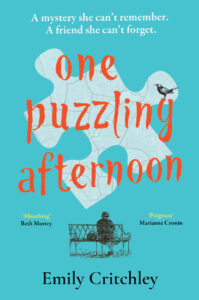
If you enjoyed this free short story, you might like my novel, One Puzzling Afternoon.